INSTITUTE FOR RESEARCH IN MOLECULAR MEDICINE

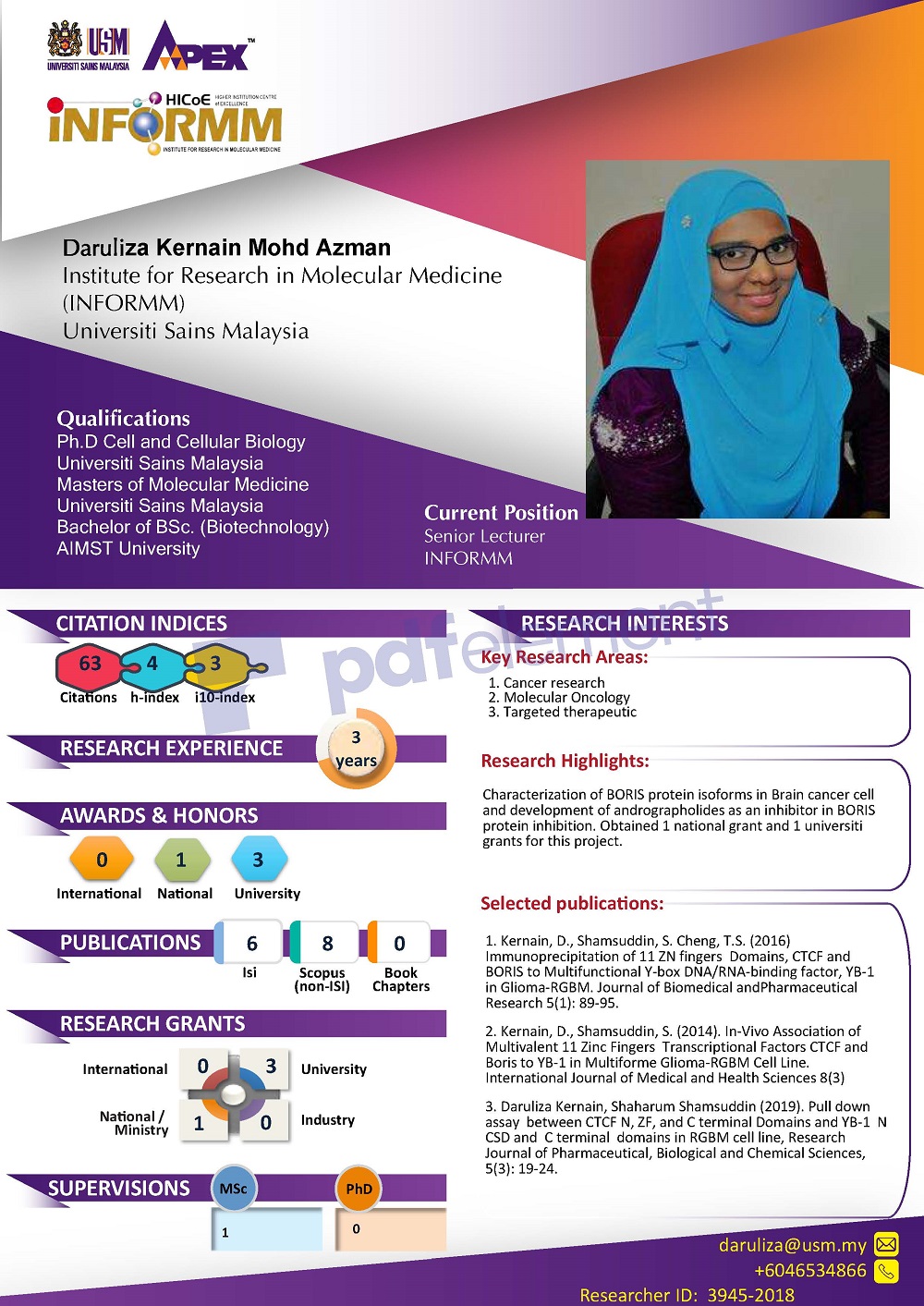
Daruliza Kernain Mohd Azman
New infografik template 2020 DARULIZA optimize

DarulizaKernain

 Name

Daruliza Kernain Mohd Azman

Current Position

Senior Lecturer

Email

daruliza@usm.my

Office Telephone

+604-6534866

Qualifications

Asian Institute for Medicine Science and Technology (AIMST) University, B. Sc in Biotechnology, 2006

Universiti Sains Malaysia (USM), M. Sc in Molecular Medicine, 2012

Universiti Sains Malaysia (USM), Ph.D in Molecular and Cellular Biology, 2016

Affiliations

Senior Lecturer

Research Interests

Molecular Oncology, Protein-protein Interaction, Cancer Biology

Research Overview 1

Regulation of Transcription and Molecular Mechanisms of Tumourigenesis

The ‘master weaver of the genome’ protein CTCF is responsible for co-ordinating three-dimensional DNA architecture within the cell nucleus. We have shown that CTCF is a tumour suppressor protein which is frequently inactivated in many cancers. CTCF tightly binds DNA through a central DNA binding domain but has terminal domains on either side with poorly defined function. CTCF has a closely related ‘brother’ protein called BORIS that binds similar DNA sites in the genome. CTCF was reported to be 95% homolog to BORIS in the central DNA binding domain. The similarity present in both proteins draw a possibility of both competing with each other to bind to the same targeted region in the cell. BORIS is a gene which is normally express in the testis and repress in the somatic cell however, it is aberrantly expressed in cancer.

Both proteins CTCF and BORIS exhibit ‘sibling rivalry’ by competing for the same sites in DNA which interferes with CTCF’s tumour suppressor function. Thus, this could lead to the functional differences outcome upon binding to the central region of the DNA and this could be due to the dissimilar sequences present in terminal domains of both DNA. The activation of a gene by CTCF when replace with BORIS at the same targeted region could result in the repression. Hence this could alter the normal physiological functions of the cell and leads to the tumour development. As a cancer testis antigen, restriction BORIS expression to cancer cells and spermatocytes represent an immunotherapeutic avenue for the treatment of many cancers. Hence, BORIS could be potential explore as a new therapeutic marker for the cancer treatment.

Selected Publications

Candida activity and brine shrimp toxicity assay of Ganoderma boninense. Daruliza KM, Fernandez L, Jegathambigai R, Sasidharan S. European Review Medical Pharmacological Sciences. 2012

Jan;6(1):43-8.

Antimicrobial activity of the crude extract of Piper sarmentosum against methicilin-resistant Staphylococcus aureus (MRSA), Escherichia coli, Vibrio cholera and Streptococcus pneumoniae. Fernandez L, Daruliza K, Sudhakaran S, Jegathambigai R. European Review Medical Pharmacological Sciences. 2012 July;16(3):105-11.

Anti-fungal effect of Hevea brasiliensis latex C-serum on Aspergillus niger. Daruliza KM, Lam KL, Yang KL, Priscilla JT, Sunderasan E, Ong MT. (2011). European Review Medical Pharmacological Sciences. 2011 Sep;15(9):1027-33.

Anti-Candida albicans activity and brine shrimp lethality test of Hevea brasiliensis latex B-serum. Daruliza KM, Yang KL, Lam KL, Priscilla JT, Sunderasan E, Ong MT. European Review Medical Pharmacological Sciences. 2011 October;15(10):1163-71.

  • Hits: 4544

Choong Yee Siew

New infografik ChoongYS 2021

yeesiew

Name

Choong Yee Siew

Current Position

Associate Professor

Email

yeesiew@usm.my

Office Telephone

+604-6534837

Qualifications

PhD, Universiti Sains Malaysia, 2008

Research Interests

Molecular modelling, Computer aided antibody design and optimization, Protein structure prediction; Molecular docking and dynamics simulation

Research Overview 1

Molecular modelling in biological research

Powerful techniques in molecular biology, x-ray crystallography and nuclear magnetic resonance spectroscopy have led to high resolution of biomolecules’ three dimensional structures. However, due to limitation of the experimental methods, molecular modelling has been applied to elucidate biomolecules’ structures. In addition, advances made in computational resources have also enabled the dynamics and the interactions of biomolecules with other molecules to be elucidated. The structural analysis could thus inform structure-function relationship as well as the modelling of biological system.

Research Overview 2

Computer-aided antibody design

Computer aided antibody design or de novo antibody design has been used to facilitate antibody discovery for diagnostics, vaccine developments or next-generation protein therapeutics due to the time and cost require by experimental approaches. The antibodies can be designed or optimized for higher affinity where the interactions with the target can be modelled at molecular level. Successful examples have been reported in the modelling at e.g. CDRs for affinity improvement and Fc effector region for modulating immune cell activity. Given that a slight error in each step could be amplified in the subsequent steps, each step in antibody design need to be studied attentively.

Selected Publications

1. Chin CF, Lai JY, Choong YS, Anthony AA, Ismail A, Lim TS. Delineation of B-cell Epitopes of Salmonella enterica serovar Typhi Hemolysin E: Potential antibody therapeutic target. Sci Rep. 2017 May 19;7(1):2176. doi: 10.1038/s41598-017-01987-8. PMID: 28526816.

2. Khor BY, Tye GJ, Lim TS, Choong YS.General overview on structure prediction of twilight-zone proteins. Theor Biol Med Model. 2015 Sep 4;12:15. doi: 10.1186/s12976-015-0014-1. Review. PMID: 26338054.

3. Lee YV, Wahab HA, Choong YS. Potential inhibitors for isocitrate lyase of Mycobacterium tuberculosis and non-M. tuberculosis: a summary. Biomed Res Int. 2015;2015:895453. doi: 10.1155/2015/895453. Epub 2015 Jan 8. Review. PMID: 25649791.

4. Leong SW, Lim TS, Tye GJ, Ismail A, Aziah I, Choong YS. Assembly and stability of Salmonella enterica ser. Typhi TolC protein in POPE and DMPE. J Biol Phys. 2014 Sep;40(4):387-400. doi: 10.1007/s10867-014-9357-9. Epub 2014 Jul 11. PMID: 25011632.

5. Khor BY, Tye GJ, Lim TS, Noordin R, Choong YS.The structure and dynamics of BmR1 protein from Brugia malayi: in silico approaches. Int J Mol Sci. 2014 Jun 19;15(6):11082-99. doi: 10.3390/ijms150611082. PMID: 24950179.

6. Choong YS, Tye GJ, Lim TS. Minireview: applied structural bioinformatics in proteomics. Protein J. 2013 Oct;32(7):505-11. doi: 10.1007/s10930-013-9514-1. Review. PMID: 24096348.

7. Tommy YB, Lim TS, Noordin R, Saadatnia G, Choong YS. Theoretical investigation on structural, functional and epitope of a 12 kDa excretory-secretory protein from Toxoplasma gondii. BMC Struct Biol. 2012 Nov 27;12:30. doi: 10.1186/1472-6807-12-30. PMID: 23181504.

8. Yung-Hung RL, Ismail A, Lim TS, Choong YS. A 35 kDa antigenic protein from Shigella flexneri: in silico structural and functional studies.

Biochem Biophys Res Commun. 2011 Nov 18;415(2):229-34. doi: 10.1016/j.bbrc.2011.09.116. Epub 2011 Oct 1. PMID: 21982766.

9. Choong YS, Lim TS, Chew AL, Aziah I, Ismail A. Structural and functional studies of a 50 kDa antigenic protein from Salmonella enterica serovar Typhi. J Mol Graph Model. 2011 Apr;29(6):834-42. doi: 10.1016/j.jmgm.2011.01.008. Epub 2011 Mar 2. PMID: 21371926.

10. Wahab HA, Choong YS, Ibrahim P, Sadikun A, Scior T. Elucidating isoniazid resistance using molecular modeling. J Chem Inf Model. 2009 Jan;49(1):97-107. doi: 10.1021/ci8001342. PMID: 19067649.  

Author Links

ResearchGate

  • Hits: 6398

Nik Yusnoraini Yusof

Nikyus New infografik template 2020

NikYusnorainiYusof

Name

Nik Yusnoraini Yusof

Current Position

Senior Lecturer

Email

nikyus@usm.my

Office Telephone

+609-7672412

Qualifications

BSc (Hons), Universiti Malaya, 2005

MRes, University of Glasgow, 2008

PhD, Universiti Kebangsaan Malaysia, 2018

Affiliations

Malaysian Society of Bioinformatics and Computational Biology (MaSBiC)

Research Interests

Bioinformatics, microbial genome analysis and protein crystallization

Research Overview 1

Bacterial genome analysis

The increased burden of carbapenem-resistant Enterobacteriaceae infection is observed worldwide including Malaysia. The emergence of this bacteria has risen a concern since carbapenem is one of the last-line antibiotic used for infection treatment. The diversity of genetic mechanisms harboured by these bacteria is the factor that facilitates its spread and complicates its identification. Thus, by analysing the genome sequence of pathogenic bacteria we will able to initiate the identification of high-risk clones of public health importance and ultimately management through the implementation of control strategies for the disease. Currently, this research involves extended spectrum beta lactamase (esbl) Escherichia coli and Klebsiella pneumoniae were isolated from our hospital setting for whole genome sequence study. Before achieving the future development of detection kit and vaccine, the comprehensive understanding of the genome of this pathogen is critically important.

Research Overview 2

Protein crystallization

The translation of genome sequence to real protein structure requires cloning, expression, purification and crystallization processes. The project aim to determine the protein structure of interested genes such as antimicrobial and virulence genes in order to better understand the pathogenic bacteria infection that can be valuable for diagnostics, drug and vaccines development.

Selected Publications

  1. Yusof NY, Muhammad Yusoff F, Muhammad Harish S, Ahmad MN & Khalid MF, Mohd Nor F, Ismail N, Aziah I. Complete senome Sequence of Leptospira kmetyi LS 001/16, isolated from a soil sample associated with a leptospirosis patient in Kelantan, Malaysia. Microbiology Resource Announcements 2019 8. 10.1128/MRA.00015-19.
  2. Samsulrizal NH, Yusof, NY. In silico prediction of cell wall remodeling genes in tomato, banana, melon and grape. International Journal of Life Sciences and Biotechnology 2019 2(2): 108-121.
  3. Yusof NY, Mohd Raih MF, Mahadi NM, Illias RM, Abu Bakar FD, Abd. Murad AM. In silico analysis and 3D structure prediction of a chitinase from psychrophilic yeast Glaciozyma antarctica PI12. Malaysian Applied Biology 2017 46(1): 117-123.
  4. Yusof NY, Abu Bakar FD, Mahadi NM, Mohd Raih MF, Abdul Murad AM. Structure prediction of Fe(II) 2-oxoglutarate dioxygenase from a psychrophilic yeast Glaciozyma antarctica PI12. AIP Conference Proceedings 2015 1678(1): 030014(1-5).

  • Hits: 2061

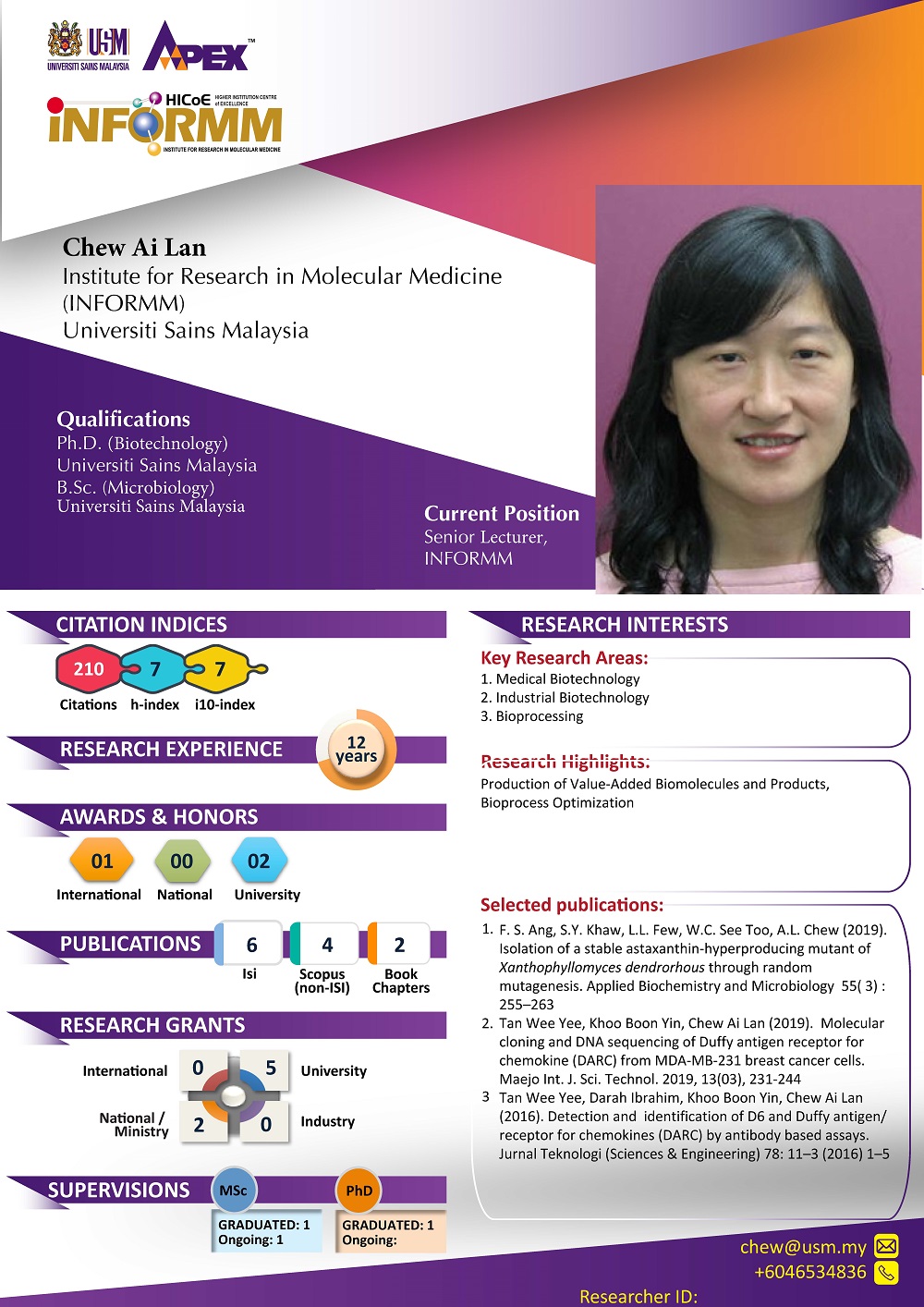
Chew Ai Lan

New infografik 2020 CAL

chew

Name

Chew Ai Lan

Current Position

Senior Lecturer

Email

chew@usm.my

Office Telephone

+604-6534836

Qualifications

PhD, Universiti Sains Malaysia, 2005

BSc, Universiti Sains Malaysia, 1997

Affiliations

Malaysian Society For Microbiology

Malaysian Society For Biochemistry and Molecular Biology

Hong Kong Chemical, Biological & Environmental Engineering Society

Research Interests

Bioprocessing, Enzyme Technology, Microbiology, Industrial Biotechnology

Research Overview 1

Biotechnological Generation of Value-added Products

The research focuses on the development and optimization of biotechnology processes to improve yield and productivity in the production of various commercially valuable products. It encompasses bioprocess scale up and strain improvement in bacteria, yeast and fungi. The work also involves the study on bioactive compounds from natural resources such as microbes and plants other than treatment of food and feed ingredients, agro and industrial waste via submerged and solid state fermentation.

Selected Publications

1.  Chew AL, James Antony JJ, Sasidharan S. Antioxidant and Antibacterial Activity of Different Parts of Leucas aspera. Asian Pacific Journal of Tropical Biomedicine 2012 2(3):176-180.

2.  Ong LGA, Chan CH, Chew AL. Enzymatic Hydrolysis of Rice Straw : Process Optimization. Journal of Medical and Bioengineering 2012 1(1):14-16.

3. Chew AL, Tan WY, Khoo BY. Potential combinatorial effects of recombinant atypical cemokine receptors in breast cancer cell invasion: A research perspective (Review). Biomedical Reports 2013 1:185-192.

4. Tan WY, Khoo BY, Chew AL. The construction of recombinant D6 clone for in vitro breast cancer study. International Journal of Bioscience, Biochemistry and Bioinformatics 2013 3(5):509-512.

5. Chan MK, Fadzil NA, Chew AL, Khoo BY. New molecular biologist perspective and insight: DNA topoisomerases production by recombinant DNA technology for medical laboratory applications and pharmaceutical industry. Electronic Journal of Biotechnology 2013 1387.

6.  Chew AL, Ang FS, Khaw SY. Xanthophyllomyces dendrorhous as a new source of enzymes and its enzymatic potential in non-carotenoid related applications. Journal of Pure And Applied Microbiology 2015 9(3):1767-1778.

  • Hits: 5584

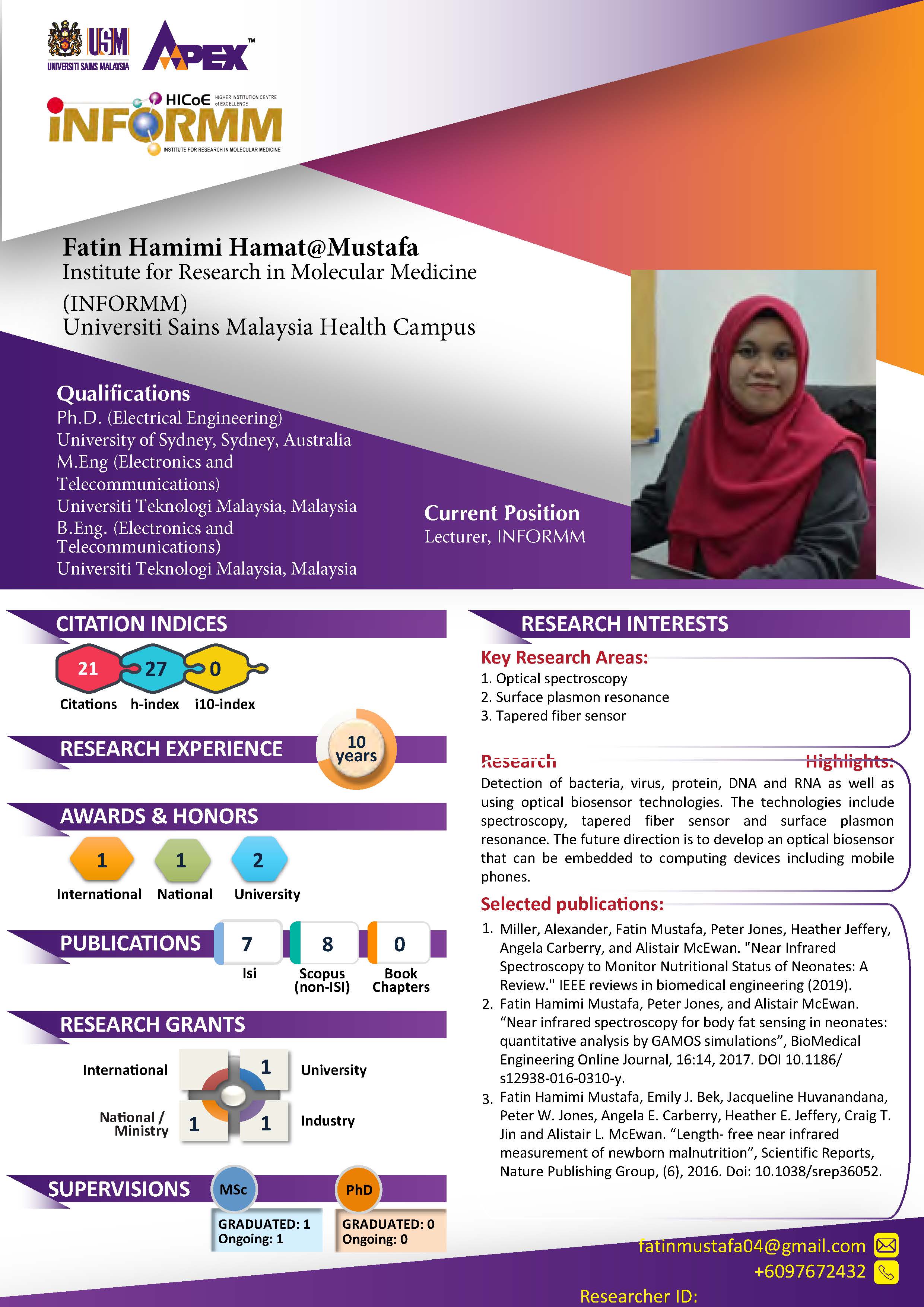
Fatin Hamimi Hamat@Mustafa

New infografik template 2020DrFATIN

FatinHamimiHamat Mustafa

Name

Fatin Hamimi Hamat@Mustafa

Current Position

Lecturer

Email

fatinmustafa@usm.my

Office Telephone

+609-7672432

Qualifications

University of Sydney, PhD in Electrical Engineering, 2017.

Universiti Teknologi Malaysia, MSc in Electrical and Electronics Engineering, 2009.

Universiti Teknologi Malaysia, BSc (Hons.) in Electrical Engineering (Electronics and Telecommunications), 2006.

Research Interests

Optical biosensor, biomedical engineering

Research Overview 1

Optical biosensor

My research interest includes detection of bacteria, virus, protein, DNA and RNA as well as using optical biosensor technologies. The technologies include spectroscopy, tapered fiber sensor and surface plasmon resonance. The future direction is to develop an optical biosensor that can be embedded to computing devices including mobile phones.

Scientific Research Overview

Current projects in the lab include:

1. Detection of Bancroftian Lymphatic Filariasis using Surface Plasmon Resonance

2. Detection of Enterovirus 71 HFMD using Optical Spectroscopy

3. Monte Carlo Simulation of Tapered Optical Fiber for Biosensing Applications

Selected Publications

  1. Fatin Hamimi Mustafa, Emily J. Bek, Jacqueline Huvanandana, Peter W. Jones, Angela E. Carberry, Heather E. Jeffery, Craig T. Jin and Alistair L. McEwan. “Length- free near infrared measurement of newborn malnutrition”, Scientific Reports, Nature Publishing Group, (6), 2016. Doi: 10.1038/srep36052.
  2. Fatin Hamimi Mustafa, Peter Jones, and Alistair McEwan. “Near infrared spectroscopy for body fat sensing in neonates: quantitative analysis by GAMOS simulations”, BioMedical Engineering Online Journal, 16:14, 2017. DOI 10.1186/s12938-016-0310-y.
  3. McEwan, A. L., S. Bian, G. Gargiulo, R. Morhard, P. Jones, F. H. Mustafa, B. Emily Bek, and H. E. Jeffery. "Low-cost near-infrared measurement of subcutaneous fat for newborn malnutrition." SPIE Smart Structures and Materials+ Nondestructive Evaluation and Health Monitoring, pp. 90600A-90600A. International Society for Optics and Photonics, 2014.
  4. F. H. Mustafa, X. Yi, A. L. McEwan, “Comparison of Geant4/Gamos with Monte Carlo Multilayer: Photon Transport in Tissue Simulating Phantom for Glucose Sensing”, The 6th European Conference of the International Federation for Medical and Biological Engineering (MBEC 2014), Dubrovnik, Croatia, 2014
  5. Fatin Hamimi Mustafa, Peter Jones, and Alistair Lee McEwan. "Improvement of Near Infrared Body Fat Sensing at 45-Degree Source-Detector Position Angle." BME- HUST 2016 International Conference on Biomedical Engineering, 2016.

Author Links

Google Scholar ID

  • Hits: 2069

More Articles …