INSTITUTE FOR RESEARCH IN MOLECULAR MEDICINE

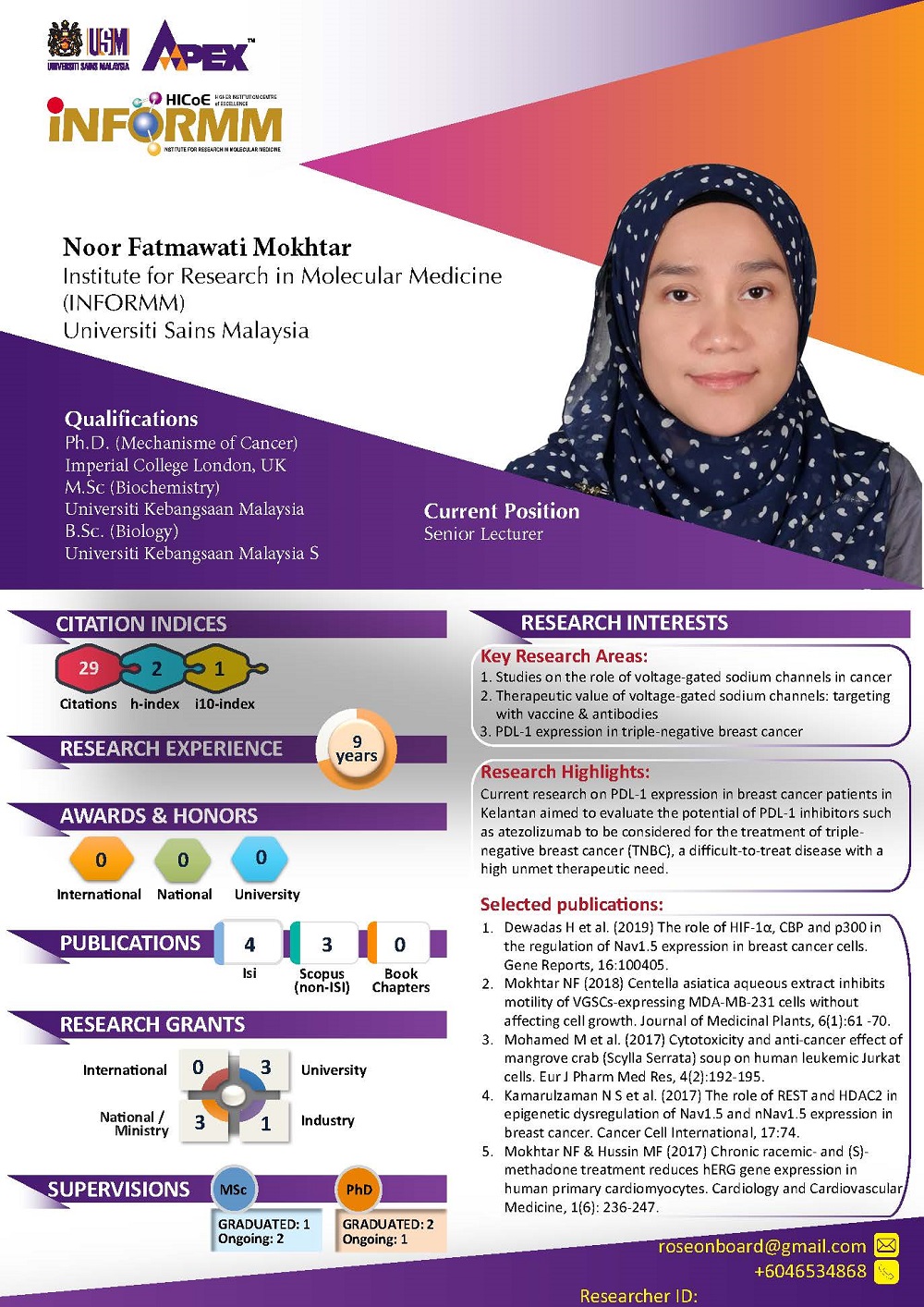
Noor Fatmawati Mokhtar

New infografik template 2020 NOOR FATMAWATI MOKHTAR

drfatma

Name

Noor Fatmawati Mokhtar

Current Position

Senior Lecturer

Email

fatmawati@usm.my

Office Telephone

+609-7672411

Qualifications

D.Phil (Mechanism of Cancer), Imperial College London, UK 2011

MSc (Biochemistry), Universiti Kebangsaan Malaysia, 2007

BSc(Biology), Universiti Kebangsaan Malaysia, 2002

Affiliations

European Society of Medical Oncology (2015 - 2017)

Research Interests

cancer, breast cancer, metastasis, voltage-gated sodium channels, epigenetics, cancer immunology

Research Overview 1

The role of hypoxia in controlling voltage-gated sodium channels (VGSCs) induced breast cancer invasiveness

This study was designed mainly to investigate the role of transcription factor, hypoxia inducible factor-1? (HIF-1?) in enhancing the expression of voltage-gated sodium channels (VGSC) particularly the isoforms, Nav1.5 and nNav1.5 in breast cancer that transforms it to become aggressive. siRNA was conducted to knockdown HIF-1? expression in the aggressive MDA-MB-231 cells whilst hypoxia-mimetic agent, cobalt chloride (CoCl2) was used to stabilize HIF-1? in the less aggressive MCF-7 cells. Total RNA and protein were extracted and subjected to real-time PCR and Western blotting. Migration and motility assays were carried out to study effect of treatments (siRNA and CoCl2) on metastatic cell behaviours. Nav1.5, nNav1.5, HIF-1? and CA9 expression were all highly expressed in MDA-MB-231 cells. siRNA caused a significant decreased in HIF-1? expression (mRNA and protein) and HIF-1?-common target gene, CA9. mRNA expression of Nav1.5 but not nNav1.5 was significantly downregulated by siRNA-HIF-1? followed by suppression of migration. When MCF-7 cells were treated with CoCl2, HIF-1? protein, CA9 and Nav1.5mRNA expression was increased significantly but not nNav1.5 followed by enhanced motility and migration. In conclusion, transcription factor, HIF-1? able to regulate Nav1.5 (but not nNav1.5) in breast cancer to promote its aggressiveness.

Research Overview 2

Elucidating the function of repressor element silencing transcription factor (REST) in human breast cancer and its relation with voltage-gated sodium channels (VGSCs)-mediated metastasis

Voltage-gated sodium channels (VGSCs) are increasingly recognized as a molecular signature for aggressive breast cancer. Knowing the compendium of factors that could regulate the expression of VGSCs in breast cancer will further our understanding of metastasis which has caused 90 % of mortality among breast cancer patients. Herein, the association of transcription factor, repressor element silencing transcription factor (REST) in regulating VGSCs (Nav1.5 and ‘neonatal’ Nav1.5) expression and metastasis mediation were investigated. Our preliminary data suggest that there could be an interaction between VGSCs and REST isolated from the weakly breast cancer which is loss in aggressive breast cancer. The loss of REST expression responsible for the upregulation of VGSCs observed in aggarssive breast cancer. Data generated from this research further our understanding on VGSCs aberrant expression in aggressive breast cancer and further demonstrate unique features of VGSCs to be considered as a potential prognostic, diagnostic and therapeutic target to combat aggressive breast cancer.

Selected Publications

1. Maizan Mohamed, Nani Izreen Mohd Sani, Aziana Ismail and Noor Fatmawati Mokhtar (2017) Cytotoxicity and anti-cancer effect of mangrove crab (Scylla Serrata) soup on human leukemic Jurkat cells. Eur J Pharm Med Res, 4(2):192-195.

2. Siti Nur Hasyila Muhammad, Noor Fatmawati Mokhtar and Nik Soriani Yaacob (2016) 15d-PGJ2 induces apoptosis of MCF-7 and MDA-MB-231 cells via increased intracellular calcium and activation of caspases, independently of ER? and ?.  Asian Pac J Cancer Prev, 17(7):3223-3228.

3. Aidil Abdul Hamid, Noor Fatmawati Mokhtar, Ekhlass M. Taha, Othman Omar and Wan Mohtar Wan Yusoff (2010) The role of ATP citrate lyase, malic enzyme and fatty acid synthase in the regulation of lipid accumulation in Cunninghamella sp. 2A1. Ann Microbiol, 61:463-468.

Author Links

Google Scholar

ResearchGate

  • Hits: 4940

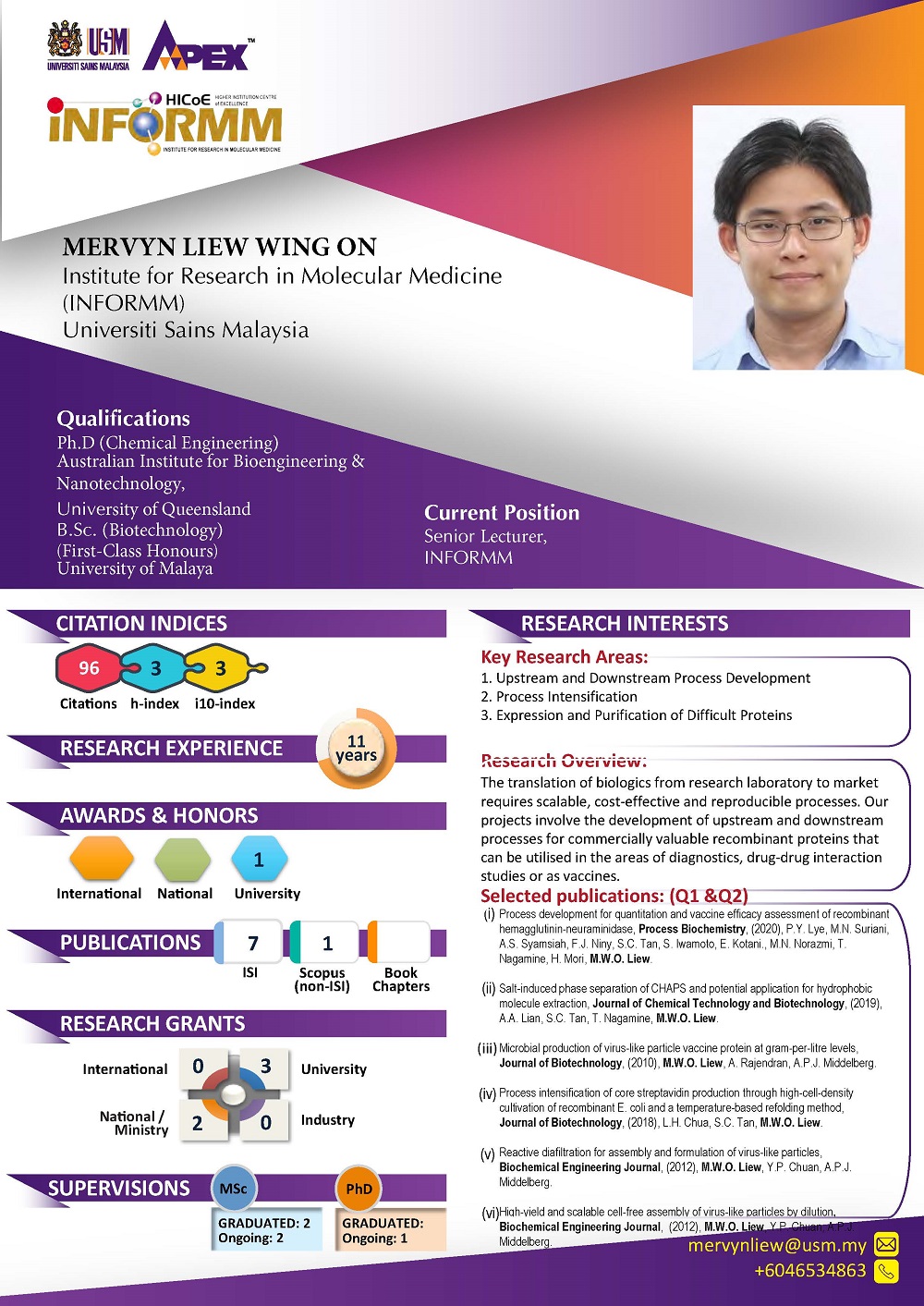
Mervyn Liew Wing On

New infografik template 2020 ML

mervyn

Name

Mervyn Liew Wing On

Current Position

Senior Lecturer

Email

mervynliew@usm.my

Office Telephone

+604-6534863

Qualifications

PhD, University of Queensland, 2013

BSc, Universiti Malaya 2006

Research Interests

Bioprocess Development, Protein Expression and Purification

Research Overview 1

Bioprocess development

The translation of biologics from research laboratory to market requires scalable, cost-effective and reproducible processes. Our projects involve the development of upstream and downstream processes for commercially valuable recombinant proteins that can be utilised in the areas of diagnostics, drug-drug interaction studies or as vaccines.

Selected Publications

1.            Liew, M.W.O., A. Rajendran, and A.P.J. Middelberg, Microbial production of virus-like particle vaccine protein at gram-per-litre levels. Journal of Biotechnology, 2010. 150(2): p. 224-231.

2.            Liew, M.W.O., Y.P. Chuan, and A.P.J. Middelberg, High-yield and scalable cell-free assembly of virus-like particles by dilution. Biochemical Engineering Journal, 2012. 67: p. 88-96.

3.            Liew, M.W.O., Y.P. Chuan, and A.P.J. Middelberg, Reactive diafiltration for assembly and formulation of virus-like particles. Biochemical Engineering Journal, 2012. 68: p. 120-128.

Lab Website

https://sites.google.com/view/mervynliewlab/home

  • Hits: 4886

Lim Theam Soon

 New infografik template 2021 lts

limtheamsoon

Name

Lim Theam Soon

Current Position

Associate Professor

Email

theamsoon@usm.my

Office Telephone

+604-6534852

Qualifications

Freie Universitat Berlin, Dr.rer.nat in Molecular Biology, 2009.

Universiti Sains Malaysia, MSc, 2006.

Universiti Malaysia Sarawak, BSc (Hons.), 2001

Affiliations

None

Research Interests

Antibody Engineering, Biosensor, DNA technology, Phage display

Research Overview 1

Antibody Engineering

The role and importance of recombinant human monoclonal antibodies for therapeutics has seen an increase in the number of antibodies going into clinical trials in the last 5 years. His lab applies phage display for the identification of novel human monoclonal antibodies against a diverse set of target antigens. The current focus of the lab is mainly on infectious diseases with the development of several immune antibody libraries. The lab has also developed several other naïve and synthetic antibody libraries for application. The libraries have since been used to develop a panel of different antibodies against several infectious disease biomarkers. Together with several other collaborators, the lab is also working to generate monoclonal antibodies against other diseases.

Research Overview 2

DNA Technology

DNA is the fundamental building block of life, where all the genetic information of a living organism is stored. In addition to that, DNA possesses unique and interesting characteristics that are capable of mediating many other functions in life. The understanding of DNA mechanistic has allowed the development of novel applications surrounding DNA mainly self assembly technologies. Manipulation of DNA is now possible for the purpose of nanostructure formation, logic gate systems and sensing applications. His laboratory is currently pioneering methods to integrate both recombinant antibody technology with DNA nanotechnology for biomedical applications.

Research Overview 3

Selected Publications

1: Fischbach J, Loh Q, Bier FF, Lim TS, Frohme M, Glökler J. Alizarin Red S for Online Pyrophosphate Detection Identified by a Rapid Screening Method. Sci Rep. 2017 Mar 24;7:45085. doi: 10.1038/srep45085. PubMed PMID: 28338022; PubMed

Central PMCID: PMC5364467.

2: Lim TS, Chan SK. Immune Antibody Libraries: Manipulating The Diverse Immune Repertoire for Antibody Discovery. Curr Pharm Des. 2016;22(43):6480-6489. doi:

10.2174/1381612822666160923111924. PubMed PMID: 27669969.

3: Lim BN, Chin CF, Choong YS, Ismail A, Lim TS. Generation of a naïve human single chain variable fragment (scFv) library for the identification of monoclonal scFv against Salmonella Typhi Hemolysin E antigen. Toxicon. 2016 Jul;117:94-101. doi: 10.1016/j.toxicon.2016.04.032. Epub 2016 Apr 14. PubMed

PMID: 27090555.

4: Ismail NF, Lim TS. Site-specific scFv labelling with invertase via Sortase A mechanism as a platform for antibody-antigen detection using the personal glucose meter. Sci Rep. 2016 Jan 19;6:19338. doi: 10.1038/srep19338. PubMed PMID: 26782912; PubMed Central PMCID: PMC4726117.

5: Chin CF, Ler LW, Choong YS, Ong EB, Ismail A, Tye GJ, Lim TS. Application of streptavidin mass spectrometric immunoassay tips for immunoaffinity based antibody phage display panning. J Microbiol Methods. 2016 Jan;120:6-14. doi:

10.1016/j.mimet.2015.11.007. Epub 2015 Nov 12. PubMed PMID: 26581498.

6: Hairul Bahara NH, Chin ST, Choong YS, Lim TS. Construction of a Semisynthetic Human VH Single-Domain Antibody Library and Selection of Domain Antibodies against ?-Crystalline of Mycobacterium tuberculosis. J Biomol Screen. 2016 Jan;21(1):35-43. doi: 10.1177/1087057115609144. Epub 2015 Sep 30. PubMed PMID:

26423338.

7: Rahumatullah A, Ahmad A, Noordin R, Lim TS. Delineation of BmSXP antibody V-gene usage from a lymphatic filariasis based immune scFv antibody library. Mol Immunol. 2015 Oct;67(2 Pt B):512-23. doi: 10.1016/j.molimm.2015.07.040. Epub 2015

Aug 12. PubMed PMID: 26277276.

8: Loh Q, Leong SW, Tye GJ, Choong YS, Lim TS. Improved Fab presentation on phage surface with the use of molecular chaperone coplasmid system. Anal Biochem. 2015 May 15;477:56-61. doi: 10.1016/j.ab.2015.02.026. Epub 2015 Mar 10. PubMed PMID:

25769419.

9: Lim BN, Tye GJ, Choong YS, Ong EB, Ismail A, Lim TS. Principles and application of antibody libraries for infectious diseases. Biotechnol Lett. 2014 Dec;36(12):2381-92. doi: 10.1007/s10529-014-1635-x. Epub 2014 Sep 12. Review. PubMed PMID: 25214212.

10: Chin ST, Ignatius J, Suraiya S, Tye GJ, Sarmiento ME, Acosta A, Norazmi MN, Lim TS. Comparative study of IgA VH 3 gene usage in healthy TST(-) and TST(+) population exposed to tuberculosis: deep sequencing analysis. Immunology. 2015 Feb;144(2):302-11. doi: 10.1111/imm.12372. PubMed PMID: 25158076; PubMed Central

PMCID: PMC4298424.

Author Address

ResearchGate

https://antibodyengineerin.wixsite.com/lts2018

  • Hits: 9062

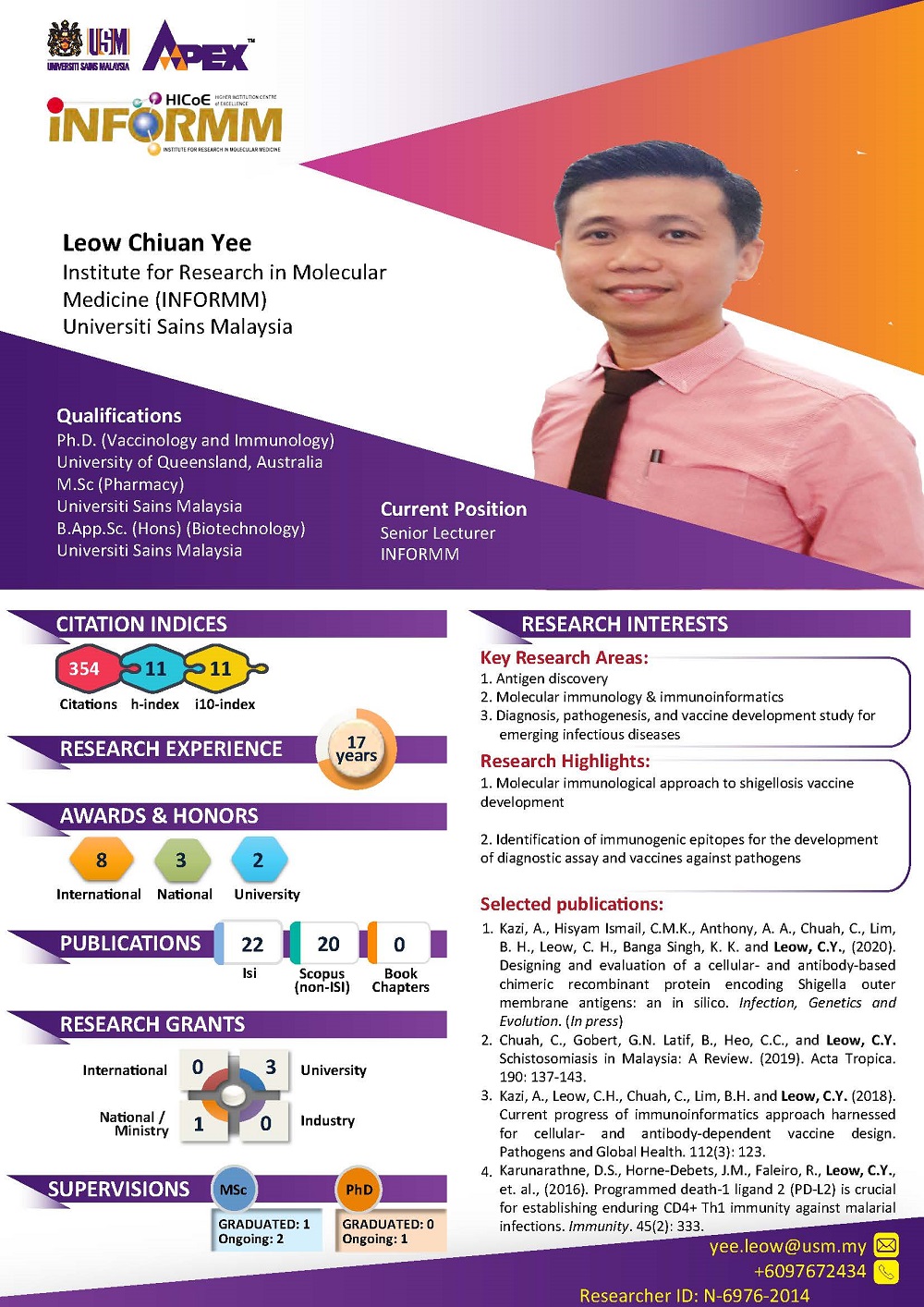
Leow Chiuan Yee

New infografik template 2020 Yee

yeeleow

Name

Leow Chiuan Yee

Current Position

Senior Lecturer

Email

yee.leow@usm.my

Office Number

106

Qualifications

PhD, University of Queensland, Australia, 2014

PgCert, Industrial Bioinformatics, Bioinformatics Institute of India, 2014

MSc, (Pharmacy) Universiti Sains Malaysia, 2006

B.App.Sc. (Hons.) (Biotechnology), Universiti Sains Malaysia, 2002

Affiliations

Young Scientists Network - Academy of Sciences Malaysia (YSN-ASM)

Malaysian Society of Parasitology and Tropical Medicines

Australian Society for Parasitology         

Research Interests

Antigen discovery, immunoinformatics, molecular immunology, emerging infectious diseases (diagnosis, pathogenesis, and vaccine development)

Research Overview 1

Molecular Immunological Approach to Shigellosis Vaccine Development

In Malaysia, Shigella spp. is the third most common bacterial agent responsible for childhood diarrhoea. Like many other tropical diseases, shigellosis cannot be sustainably controlled by mass drug administration due to the possibility of antibiotic resistance. Therefore, a vaccine is desperately needed to combat this microbial pathogen. Prior to achieve this, the comprehensive understanding of immune response associated with shigellosis is critically important. Shigella infection represents an interesting paradigm of imbalance of the host immune mechanisms that regulate inflammation, and of bacterial strategies developed to escape killing by host immune cells that are equipped with a large repertoire of anti-microbial weapons to control microbial infection. Previous study showed that in vivo activation of T cells in the blood in patients during shigellosis and a correlation between the degree of T-cell activation and disease severity, confirming the importance role of cell-mediated immune response during Shigella infection. To understand the role of cellular T cells in the pathogenesis of and protection against Shigella infection and to further the development of effective vaccines, knowledge about Shigella derived molecules or epitopes that may induce T-cell-specific responses is required.

Research Overview 2

Identification of immune epitopes for the development of diagnostic assay and vaccines against pathogens

Brucellosis is endemic in many developing countries and is caused by Brucella species that affect human, domestic and some wild animals. In livestock, Brucella causes abortion, still birth, reduced milk production and infertility, thus directly affecting livestock related food production. This zoonosis disease has made a significant economic impact in livestock that is widely distributed among cattle and related wildlife species. Human brucellosis has been reported in Malaysia since 2000. More importantly, food borne brucellosis in human was first reported in 2010 involving a seven-year boy after after consumed a Brucella infected raw milk. Recently, several outbreaks of brucellosis have been reported among humans in Malaysia which were associated with the consumption of raw cow’s milk contaminated primarily with B. abortus and occasionally with B. melitensis and B. suis. Owing to the cross-reactivity of Brucella LPS with other Gram negative bacteria, and the lack of available vaccine, our primary research interest is to understand pathogenesis and immunology of brucellosis and hence contributing towards the diagnostic assays and vaccines development against this intracellular pathogen.

Selected Publications

1. Karunarathne, D.S., Horne-Debets, J.M., Faleiro, R., Leow, C.Y., et. al., (2016). Programmed death-1 ligand 2 (PD-L2) is crucial for establishing enduring CD4+ Th1 immunity against malarial infections. Immunity. 45(2):333-45.

2. Leow, C.Y., Willis, C., Hofmann, A., and Jones, M.K. (2015). Structure-function analysis of apical membrane-linked molecules for treatment and control of schistosome parasites of humans: insights from studies into annexins. British Journal of Pharmacology. 172: 1653.

3. Wykes, M.N., Horne-Debets, J.M., Leow, C.Y. and Karunarathne, D. (2014). Malaria drives T cells to exhaustion. Front. Microbiol. 5:249.

4. Leow, C.Y., Willis, C., et. al. (2014). Crystal structure and immunological properties of the first annexin from Schistosoma mansoni - Insights into the structural integrity of the schistosomal tegument. FEBS Journal. 281(4): 1209-1225.

5. Cantacessi, C., Seddon, J.M., Miller, T.L., Leow, C.Y., et. al., (2013). A genome-wide analysis of annexins from parasitic organisms and their vectors. Scientific Reports. 3: 2893.

6. Hofmann, A., Osman, A., Leow, C.Y., Driguez, P., McManus, D.P., and Jones, MK. (2010). Parasite annexins - new molecules with potential for drug and vaccine development. BioEssays, 32: 967–976.

Author Links

Google Scholar

  • Hits: 4980

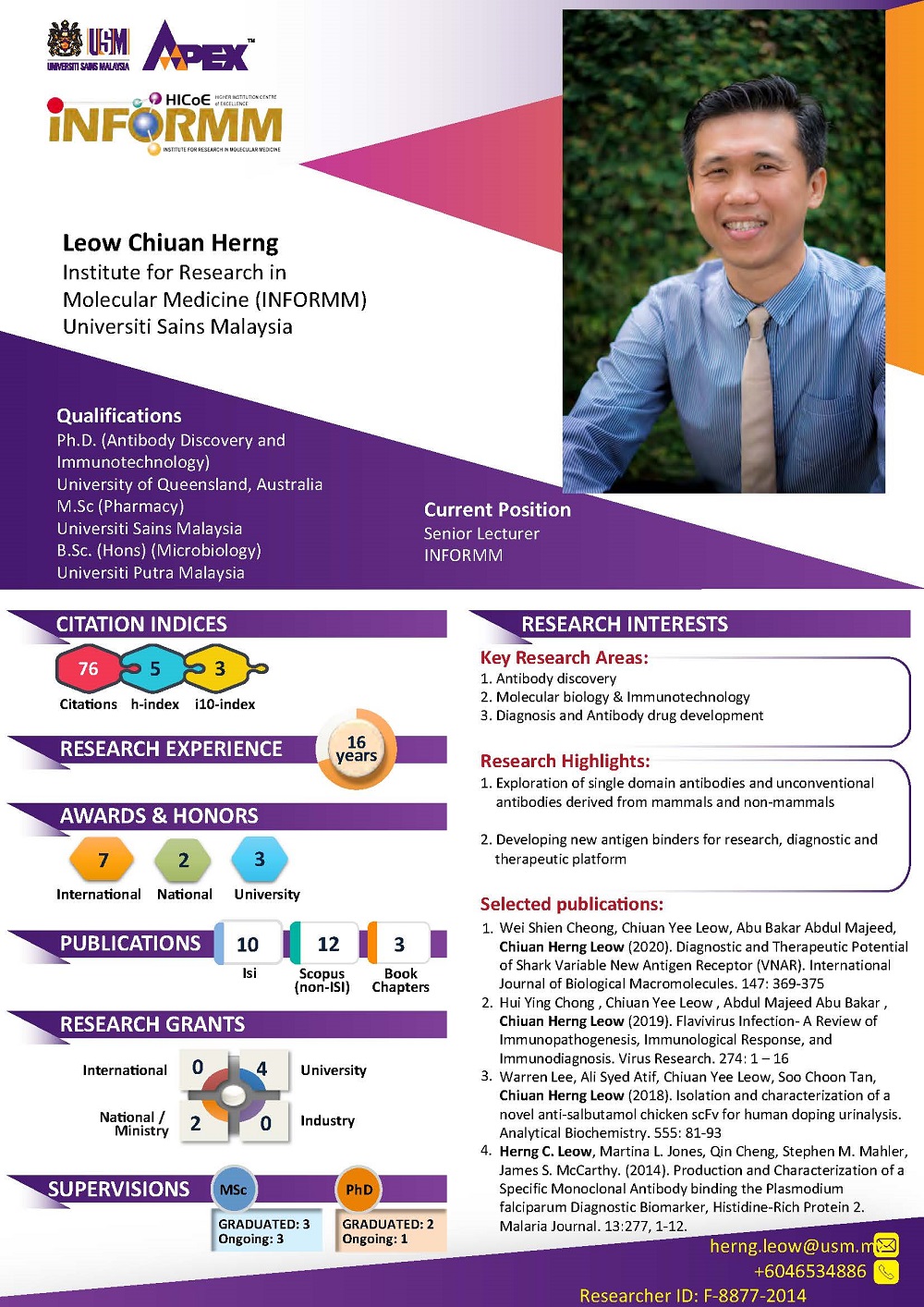
Leow Chiuan Herng

New infografik template 2020 Herng

leow

Name

Leow Chiuan Herng

Current Position

Senior Lecturer

Email

herng.leow@usm.my

Office Telephone

+604-6534886

Personal Lab Website

None

Qualifications

B.Sc. (Hons) (Microbiology), Universiti Putra Malaysia (2002)

M.Sc. (Pharm Biotechnology), Universiti Sains Malaysia (2006)

PhD (Medicine), University of Queensland, Australia (2014)

Affiliations

Member of The Antibody Society (USA)

Member of Malaysian Society of Parasitology and Tropical Medicine (MSTPM)

Affiliate of Young Scientists Network?Academy of Sciences Malaysia (YSN-ASM)

Research Interests

Antibody, Fermentation, Immunology, Single domain antibody, Phage display, Recombinant protein expression

Research Overview 1

Exploration of shark single domain antibodies

Antibodies are the most useful molecules for biomedical applications. In recent years, a new set of natural sdAb fragments namely VHHs, VNARs and VLRs were discovered in camelids, sharks and lampreys, respectively. Due to their unique characteristics, including small size, high thermostability and long CDR3 region for better penetration, these new binders are now investigated extensively as a substitute for conventional antibodies.His laboratory is currently interested to explore the functional of shark VNARs by constructing naive, immunized and semi-synthetic antibody libraries targeting towards range of antigens derived from different diseases.

Research Overview 2

Isolation of anti-salbutamol scFv from chicken phage display library

To date, salbutamol is a preferred ?2-agonist drug of abuse in athletics and as a livestock growth promoter due to its inexpensiveness. Antibodies remain key biomolecules for the detection and isolation of ?2-agonists.  In this study, the use of the chicken (Gallus gallus domesticus) as an immunization host for the generation of a monoclonal anti-salbutamol antibody by phage display is investigated. A single chicken immunized against SAL-KLH conjugate was used to construct the phage display library  from which a single scFv clone was isolated and was reactive to salbutamol. Soluble and functional scFv protein was expressed in Escherichia coli T7 SHuffle Express B (DE3) strain .

The scFv was then reformatted into scFv-murine-IgG1 Fc by expression in HEK 293T cells. Further evaluation of the cross-reactivity of the two antibody formats towards other relevant ?2-agonists revealed that the antibodies had significant cross-reactivity towards clenbuterol. Based on the affinity of the antibodies towards the two ?-agonists (IC50 salbutamol = ~0.310 ?g/ml (scFv), x ?g/ml (scFv-Fc); IC50 clenbuterol = ~0.076 ?g/ml (scFv), y ?g/ml (scFv-Fc)), they were deemed potentially suitable as antibodies for immunochromatographic-capture solid phase extraction (SPE) for the simultaneous detection of salbutamol and clenbuterol by more sensitive methods such as LC-MS or GC-MS.

Research Overview 3

Exploration of anti-JE NS1 from human scFv library

Japanese Encephalitis virus( JEV) is known to be serologically similar with other flavivirus such as Dengue virus, West NileZika virus, Yellow Fever virus and  others. Co-existence of these viruses with highly homologous antigenic epitopes results in antibody-based serodiagnosis being inefficient at detecting and distinguishing JEV efficiently from other flaviviruses. This often causes misdiagnosis and inaccurate treatments of flavivirus infection. Co-localization of the JEV NS1 protein with the membrane of JEV-infected cells renders the protein a potential target. For this reason, the NS1 viral replication protein that is reported to confer specificity against JEV is frequently used as antigenic marker in this study to generate human antibody fragment against JEV. For futureTo imporove  the JEV diagnostic applicationtest, we have constructed a human semi-synthetic library that displaying single chain antibody fragment. Complementary determining region 3 (CDR3) of heavy chain and light chain are synthetically randomized by using degenerate codons. VH and VL are were then linked via glycine-serine linker by splice overlap extension PCR strategy in respect to form construct a highly diverse scFv phage display antibody library. Of that, a library size of 4.8 x 10⁶ is generated. DNA sequencing revealed the quality of library constructed in this study was good with that approximately 60% of in-frame the libraryscFv repertoires identified has the potential to express in- frame scFvs. As a result, it may lead to  This antibody repertoire is highly diverse with all the clones sequenced confer distinct and unique sequences at the CDR3. Presently, this library is ready to deploy for specific clones selection against our in-house synthetic recombinant JE NS1 proteinby undertaking repetitive biopanning.

Selected Publications

  1. Warren Lee a, Ali Syed Atif b, Soo Choon Tan a, Chiuan Herng Leow. (2017) Insights into the chicken IgY with emphasis on the generation and applications of chicken recombinant monoclonal antibodies. Journal of Immunological Methods (In Press).
  2. Herng C. Leow, Martina L. Jones, Qin Cheng, Stephen M. Mahler, James S. McCarthy. (2014). Production and Characterization of a Specific Monoclonal Antibody binding the Plasmodium falciparum Diagnostic Biomarker, Histidine-Rich Protein 2. Malaria Journal. 13:277, 1-12.
  3. Gam, LH., Leow, CH., Man, CN., Gooi, BH., Manjit, S.  (2006). Analysis of differentially expressed proteins in cancerous and normal colonic tissues.  World J. Gastroenterol. 12(31): 4973-4983.

Author Links

Google Scholar

Researcher ID: F-8877-2014

ORCID

ResearchGate

Scopus

  • Hits: 5905